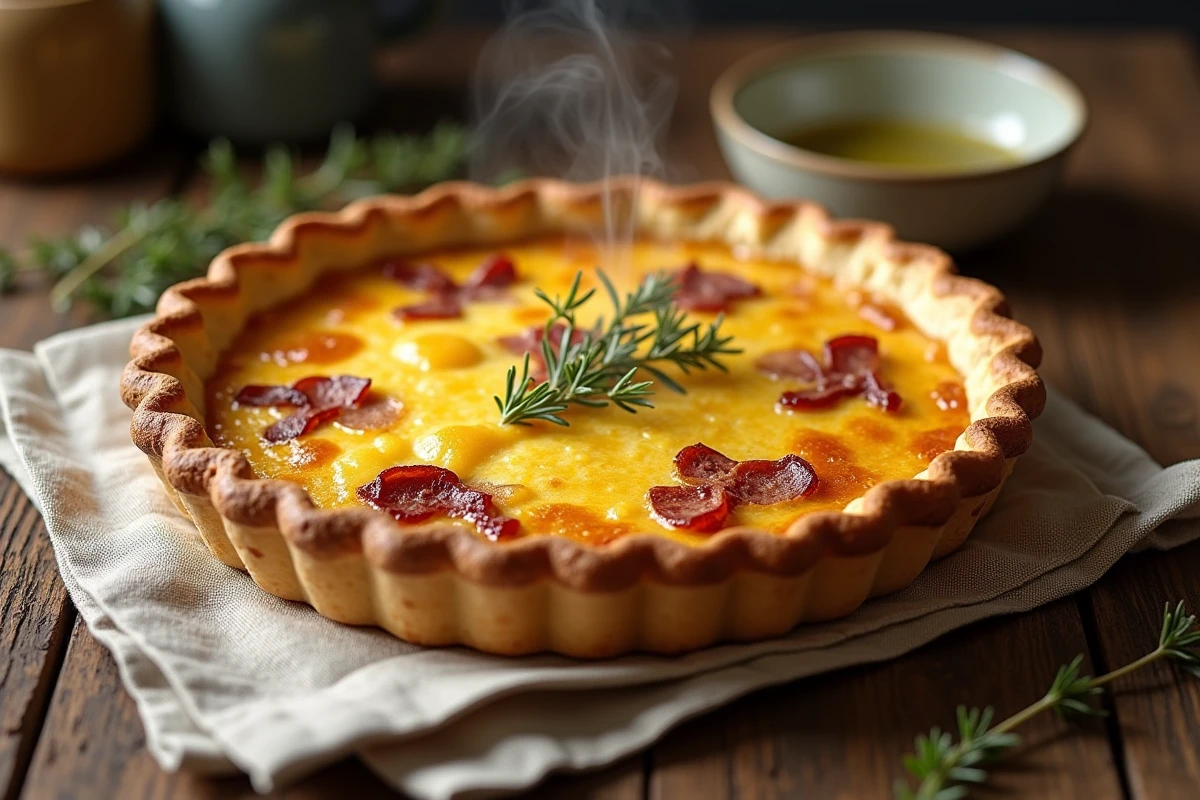
Adapting a quiche lorraine to the mold you have means solving a volume problem, not a diameter one. Most recipes provide quantities for a standard mold without specifying which one, leading to either a filling that is too thin and dries out during cooking, or a mixture that overflows. To successfully make your homemade quiche lorraine, the variable to master is the height of the filling in the mold, not the number of servings aimed for.
Height of filling: the calculation that quiche recipes do not provide
Ferrandi Paris and the Paul Bocuse Institute emphasize in their recent educational materials a simple principle: aim for a constant filling height of 2 to 3 cm for a classic quiche. For a thick catering-style quiche, this height goes beyond that. This reasoning in terms of filling thickness replaces the usual reflex of multiplying or dividing ingredients based on diameter.
A small-diameter tart pan with high sides can hold as much filling as a wide pan with low sides. Thinking only in centimeters of diameter can lead to sometimes considerable proportion errors.
To determine the useful volume of your mold, the most reliable method remains to fill it with water and measure the resulting quantity. This data, in milliliters, then allows for precise adjustments to the recipe. By consulting the tips from Gourmandises et Cie, you will find concrete benchmarks to convert this volume into proportions of eggs, cream, and bacon.
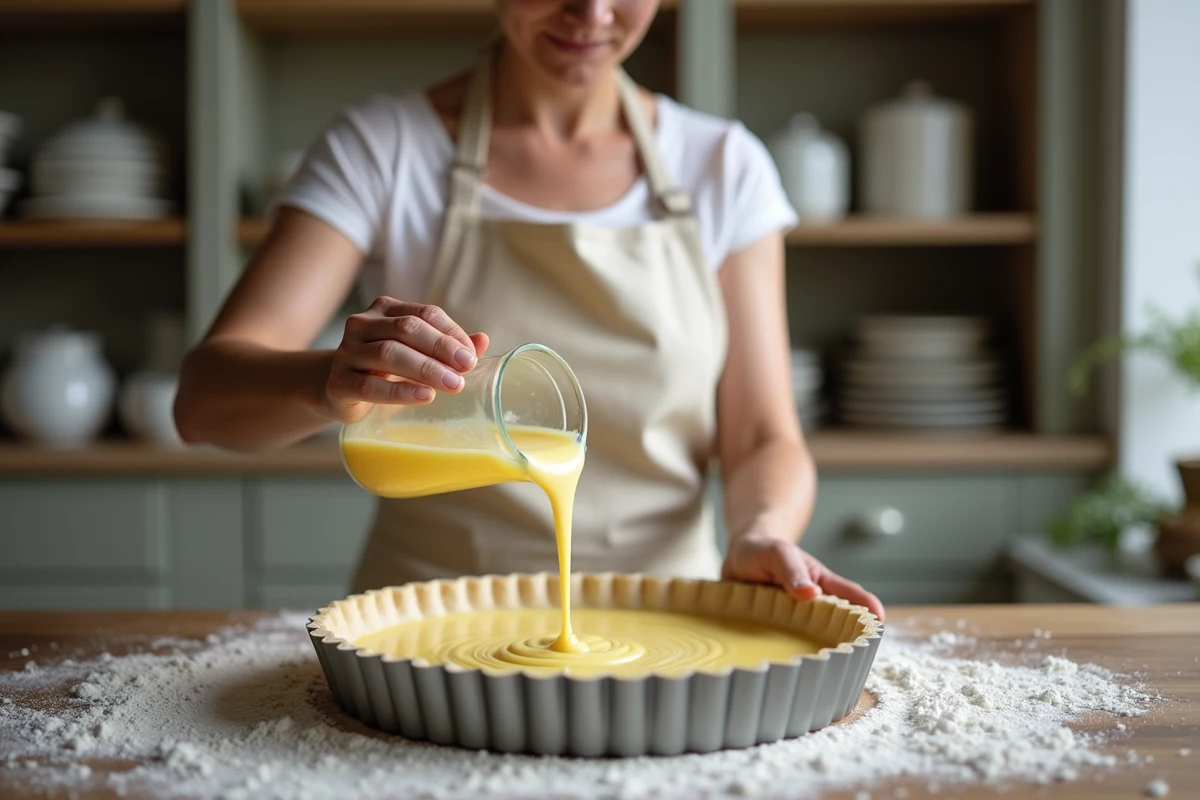
Proportion table according to the volume of the mold
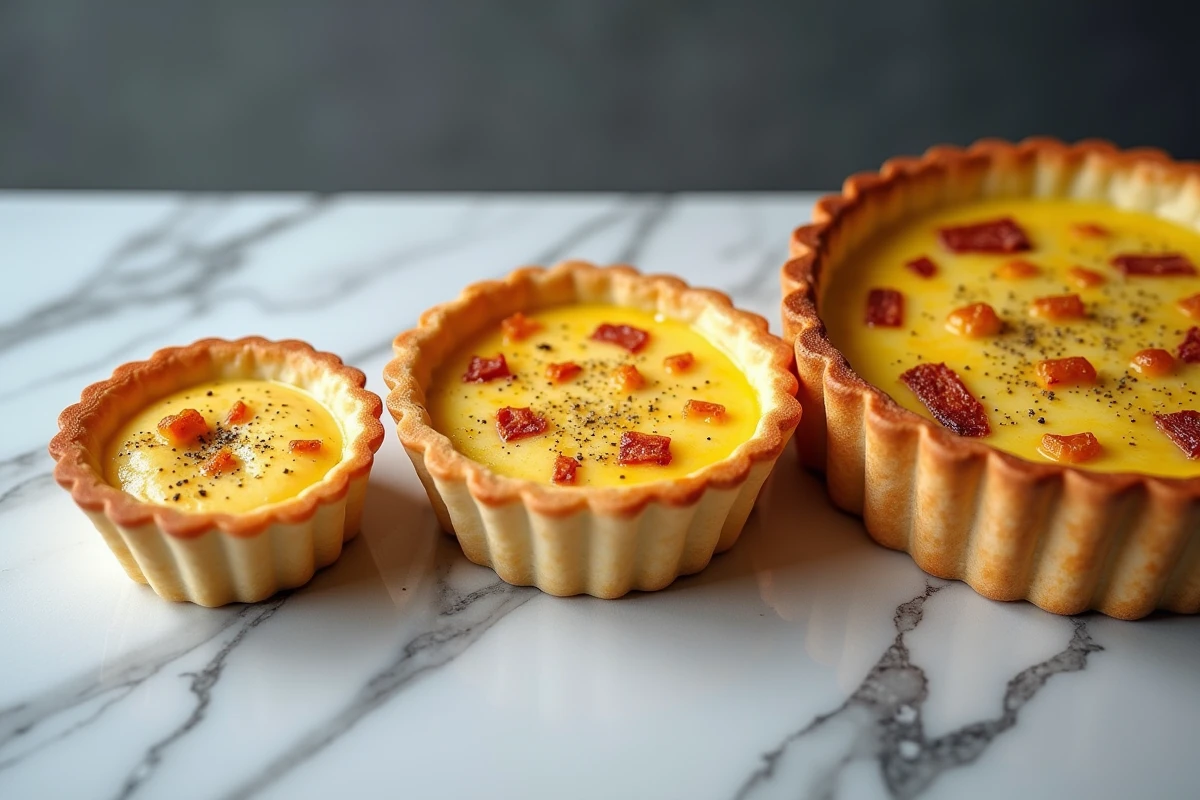
The table below is based on the principle of a constant filling height, adapted to common molds. The quantities of dough vary according to the surface to be lined, while the filling depends on the internal volume.
| Type of mold | Shortcrust pastry | Eggs | Liquid cream | Bacon |
|---|---|---|---|---|
| Small (low volume, high sides) | Reduced quantity | 2 | About 15 cl | Moderate portion |
| Standard (medium diameter) | Classic quantity | 3 | About 20 cl | Standard portion |
| Large or rectangular (high volume) | Increased quantity | 4 to 5 | About 30 cl | Generous portion |
These benchmarks serve as a base. The egg/cream ratio determines the consistency of the mixture: too much liquid compared to the eggs results in a soft quiche in the center, while not enough liquid produces a rubbery texture.
Silicone, metal, ceramic molds: the impact on cooking
The material of the mold alters thermal conductivity and thus the cooking time at equal filling volume. A dark metal mold heats quickly and promotes a crispy tart base. A silicone mold transmits heat more slowly, which extends the cooking time and makes unmolding more delicate if the pastry is not cooked enough.
Ceramic, on the other hand, gradually stores heat. The result is often consistent, but the oven time increases compared to metal. Adjusting the cooking time to the material of the mold prevents soggy bottoms.
Actual temperature deviation of the oven: an underestimated factor
Tests conducted by UFC-Que Choisir and 60 Millions de Consommateurs on domestic ovens reveal that a 10 to 20 °C overstatement or understatement of temperature is common. For a quiche lorraine, this deviation changes everything.
An actual temperature that is too low produces a filling that does not set in the center within the allotted time. The reflex is then to extend the cooking time, which dries out the edges and the surface. Conversely, an actual temperature that is too high colors the top before the pastry base is set.
- Investing in an independent oven thermometer allows you to know the actual deviation of your appliance and adjust the setting accordingly.
- Preheating the oven for at least fifteen minutes before baking stabilizes the internal temperature and reduces variations during cooking.
- Placing the mold on the bottom rack during the first few minutes promotes cooking of the pastry base before the filling is set.
These adjustments have a more pronounced effect on large molds, where the mass of filling to cook is greater and where temperature deviations result in unevenly cooked areas.
Lightened quiche lorraine with bacon: adjusting the filling without losing texture
The recommendations from ANSES updated in 2023 as part of the National Nutrition Health Program have encouraged several culinary training organizations to offer versions of quiche lorraine reduced in charcuterie. Reducing the bacon without compensating in the filling results in a bland and flat quiche.
The technique consists of keeping the total volume of filling constant by slightly increasing the proportion of cream or adding an egg. The structure of the filling remains stable, and the reduction of bacon does not result in a mixture that is too liquid or an unbalanced taste.
Adapting proportions to a rectangular mold
Rectangular molds, common in home cooking, pose an additional calculation problem. Their volume cannot be derived from a simple diameter. You need to multiply length, width, and useful height to obtain the volume in cubic centimeters, then convert it to milliliters.
A large rectangular mold with low sides requires more dough for lining, but less filling in height. The main risk is a quiche that is too thin, which dries out in just a few minutes of excessive cooking. It is better to reduce the oven time by a few minutes and monitor the setting of the filling through the glass.
Adapting a quiche lorraine recipe to a given mold relies on three measurable data: the volume of the mold, the target filling height, and the actual oven temperature. By combining these three parameters, the proportions can be calculated without approximation, regardless of the format of the dish used.