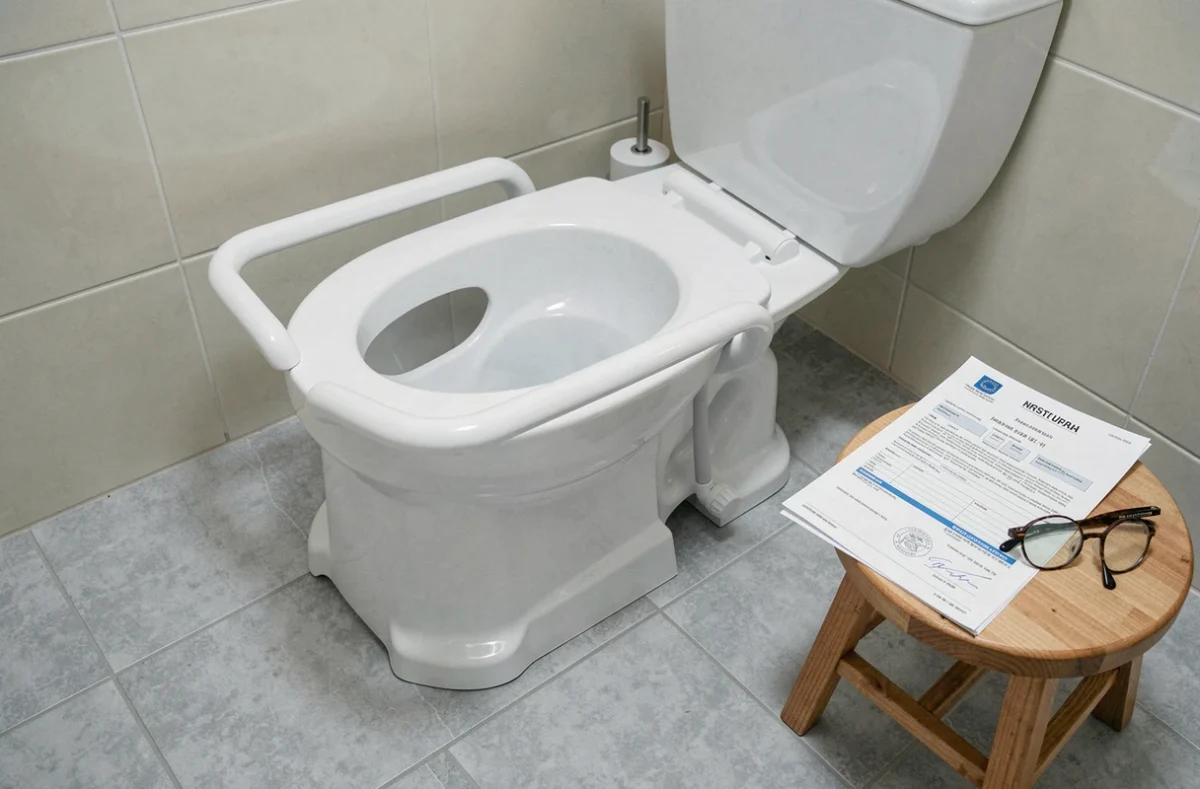
A toilet seat riser purchased at a pharmacy seems to fall under reimbursable medical equipment. The administrative reality is harsher: this product, placed directly on the toilet bowl, is not listed on the List of reimbursable products and services (LPP) of the Health Insurance. The confusion with other similar equipment, such as commodes, leads to refusals of coverage that many families discover afterward.
LPP Code and Toilet Seat Riser: Why the Nomenclature Blocks Reimbursement
The Health Insurance only reimburses products listed on the LPP, identified by a specific code. A standard toilet seat riser does not have an LPP code. Even a prescription written by a specialist cannot trigger coverage for a product absent from this list.
The commercial vocabulary blurs the lines. In pharmacies, a riser is often found alongside commodes and toilet frames, in the same “home care” aisle. The label does not reflect the administrative category of the product.
To know if a piece of equipment is reimbursable, one must look at the exact designation and the LPP code on the quote or invoice. An item sold under the name “riser” but corresponding to a commode listed on the LPP may be eligible for reimbursement. The opposite is also true: a commode without a valid LPP code will not be covered.
Understanding this distinction between the reimbursement of the toilet seat riser in pharmacies and that of a commode listed on the LPP helps avoid an outright rejected file.
ALD and Prescription: Two False Guarantees of Coverage
Patients with long-term illnesses (ALD) often assume that this status covers all medical purchases related to their condition. This is not the case. An ALD does not make a product absent from the LPP reimbursable. The official Ameli forum specifies: ALD exempts from the co-payment on already reimbursable care and products, without expanding the scope of the list.
The prescription generates a comparable misunderstanding. A doctor may prescribe a toilet seat riser for legitimate medical reasons, for example, after hip replacement surgery or in the face of severe osteoarthritis. This prescription does not lead to any reimbursement if the product does not have an LPP code. However, it may serve as proof in other applications, which perpetuates the confusion.
What the Prescription Actually Allows
- Support a request for financial aid from the departmental council (APA) or the MDPH (PCH), certifying the medical need
- Form a part of a file for a request for exceptional aid from the CPAM, examined on a case-by-case basis according to the applicant’s resources
- Lead to an evaluation by an occupational therapist, who can determine if another piece of equipment listed on the LPP, such as a commode, would meet the same need
The prescription thus has a function, but not the one that most buyers imagine when paying at the pharmacy.
Commode and Riser: The Administrative Boundary That Changes Everything
The commode is among the toilet equipment listed on the LPP. Its reimbursement requires three conditions to be met: a medical prescription, a product corresponding to the exact LPP reference, and a purchase from an authorized supplier.
What separates the riser from the commode is neither the height nor the shape of the seat. It is the regulatory classification. Hybrid models, marketed under names like “riser with armrests” or “elevated toilet frame,” may visually resemble a commode without having the corresponding LPP code.
Two checks on the quote, before any purchase at a pharmacy, can help anticipate a refusal:
- The correspondence between the indicated LPP code and the category “commodes / bedside commodes” of the official nomenclature
- The mention of the responsibility rate, which corresponds to the amount used as the basis for calculating the Health Insurance share
If either of these elements is missing, the product will not be covered, regardless of its price and medical utility.

Financial Aids Outside Health Insurance for a Toilet Seat Riser
The absence of reimbursement by Social Security does not close all possibilities for funding. Several schemes exist, but they fall under different administrative circuits.
The APA (personalized autonomy allowance) can include a riser in the support plan for an elderly person with loss of autonomy. The request is made to the departmental council, after a home evaluation. The PCH (disability compensation benefit) follows a similar mechanism for people with disabilities.
Some pension funds offer one-time aids intended for home adaptations, particularly for equipment that facilitates staying at home. Eligibility conditions and amounts vary by fund.
A request for exceptional aid from the CPAM remains possible, even for a product outside the LPP. The Ameli forum indicates that the fund may, based on the financial and medical situation, grant a contribution. This route is discretionary and requires a documented file.
Before purchasing, consulting an occupational therapist remains the most reliable reflex. This professional can determine if the patient’s need actually corresponds to a reimbursable product, such as a commode, rather than a standard riser, and guide the file toward the appropriate funding circuit.