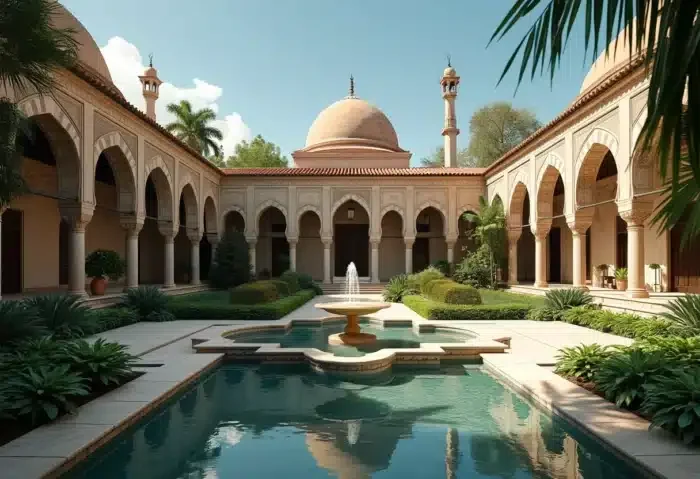
Heavenly rewards in Islam, also known as ‘jannah’ or paradise, have always been a central and fascinating theme for believers. Traditionally, they are described in the Quran and hadiths as lush gardens, rivers of milk and honey, and eternal pleasures reserved for those who have led a pious life. These descriptions have provided a tangible and motivating vision of the afterlife for Muslims throughout the centuries.
Today, these concepts are interpreted with a sometimes more symbolic perspective. Modern scholars often emphasize the importance of spiritual and moral development as the true reward. Rather than focusing solely on material descriptions, they highlight inner bliss and closeness to the divine as the ultimate aspiration. This approach reflects an evolution towards a more introspective and philosophical understanding of Islamic teachings.
Traditional Interpretations of Heavenly Rewards in Islam
Traditional interpretations of heavenly rewards in Islam are closely linked to sacred texts such as the Quran and the Hadiths. Islamic mythology centers on these narratives, revealing visions of paradise, or Jannah, and hell, or Jahannam. These texts, revealed to the prophet Muhammad by the angel Gabriel, describe Jannah as a place of eternal delights, richly illustrated with gardens, rivers, and palaces.
Quranic Descriptions
In the Quran, descriptions of Jannah are often very visual:
- Gardens beneath which rivers flow
- Abundant and varied fruits
- Pure companions
- Sumptuous pavilions
These images are intended to motivate Muslims to lead a pious life and to follow the commandments of Allah. The Hadiths complement these descriptions and introduce concepts such as Barzakh, the intermediate state between death and resurrection, and Al-Sirat, the bridge that every soul must cross to reach paradise.
Why 72 Virgins
The question of ‘Why 72 Virgins’ is often raised in connection with heavenly rewards. This number, mentioned in some Hadiths, is symbolically interpreted by many scholars, representing purity and the abundance of divine rewards rather than literally. Interpretations vary, but the central idea remains that the pleasures of paradise are beyond what the human mind can conceive.
Consider that the traditional view of heavenly rewards is based on a complex combination of Quranic texts and prophetic narratives. These descriptions are both divine promises and guides for a life in accordance with Islamic precepts.
Modern Interpretations of Heavenly Rewards in Islam
Modern interpretations of heavenly rewards in Islam, while rooted in traditional texts, tend to approach these concepts with a more symbolic and metaphorical perspective. Contemporary thinkers, such as Al-Ghazâlî, Ibn Taymiyya, and Al-Jawziyya, have explored these themes by linking them to the social and moral realities of the modern world.
Contemporary Approaches
Modern interpretations often focus on the ethical dimension of Islamic teachings. Rather than viewing the descriptions of Jannah and Jahannam as physical realities, these scholars consider them as metaphors for the moral and spiritual state of the individual. This view is partly influenced by the need to adapt religious concepts to contemporary challenges.
Human Brotherhood
Another dimension of modern interpretation is the emphasis on human brotherhood and social justice. The document on human fraternity, signed in Abu Dhabi, illustrates this trend. This text highlights collaboration between Muslims and Christians to promote peace and justice in the world.
Comparative Table
| Aspect | Traditional | Modern |
|---|---|---|
| Description of Jannah | Gardens, rivers, palaces | Spiritual state of peace |
| Jahannam | Physical hell | Moral consequence |
Consider that modern interpretations seek to harmonize Islamic teachings with universal values of justice, peace, and brotherhood.